
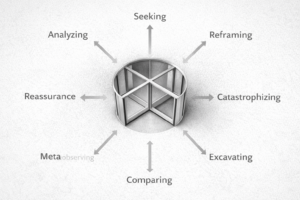
Something tightens in your chest. Maybe after a conversation that went wrong. Maybe for no reason at all. The sensation is there — pressure, heat, contraction. Unmistakable.
And then, before you even notice it happening, you’re somewhere else.
Not physically. Mentally. You were with the sensation for half a second. Now you’re thinking about it. Analyzing what caused it. Planning how to fix it. Wondering if you should try that new meditation technique. Comparing how you feel today versus last week.
You’re busy. You’re engaged. It feels like you’re doing the work.
You’re not. You left.
The mind has eight reliable ways to leave sensation the moment it gets uncomfortable. Eight exit doors from the revolving door. Each one feels like engagement. Each one is an escape. And until you can see yours in real time, you’ll keep mistaking exit for contact.
The Moment Before the Door
First — what’s actually happening when sensation arises and the mind bolts.
Something activates. The nervous system picks up a signal — contraction, unease, the hum of arousal that hasn’t found an object yet. For a fraction of a second, this is just sensation. Raw. Unlabeled. Present.
Then the alarm fires. The system reads the activation as threat. The blinds close. And now you’re no longer in direct contact with what’s here. You’re in the mind’s theater, watching its response to what’s here.
The exit door opens right there — in the gap between sensation arising and the mind’s response to it. The gap is tiny. Milliseconds. By the time you notice you’ve left, you’re already three rooms away, engaged in something that feels productive.
That’s what makes these exits so hard to catch. They don’t feel like leaving. They feel like arriving somewhere useful.
Door 1: Analyzing
The mind’s favorite. The one most people with any self-awareness default to.
Sensation arises. Immediately: “Why am I feeling this? What triggered it? Is it the conversation from earlier? The email I haven’t sent? Is this the attachment pattern or the abandonment pattern?”
The analysis is often accurate. That’s what makes it so seductive. You’re not wrong about the trigger. You’re not wrong about the pattern. The insight might even be genuinely new.
But notice what happened: you were with a sensation in your chest. Now you’re in your head, mapping causes. The sensation is still there — untouched, unfelt, waiting. You built an explanation around it instead of staying with it.
Analyzing feels like understanding. It functions as distance.
The tell: you can explain exactly what you’re feeling and why, but the feeling hasn’t moved. The map got more detailed. The territory was never visited.
Door 2: Seeking
“I need a better teacher. A different practice. Maybe that breathwork retreat. Maybe microdosing. Maybe I should try that somatic therapist everyone’s talking about.”
Seeking turns the current sensation into evidence that you haven’t found the right approach yet. The discomfort isn’t something to feel — it’s proof that the solution is elsewhere.
This one powered three years of my life. Every contraction became a signpost pointing somewhere else. Every uncomfortable moment was evidence that I hadn’t arrived yet, which meant the real answer was still out there, which meant the correct response to this feeling was to go find something better.
The sensation? Never felt. It was already converted into fuel for the next search.
The tell: the discomfort triggers a plan. Not a plan to feel it — a plan to find the thing that will make it stop.
Door 3: Reframing
“This contraction is actually growth. This discomfort means something is shifting. This is my nervous system rewiring.”
Reframing takes raw sensation and gives it a positive story. The feeling hasn’t been felt. It’s been relabeled. The tightness in your chest was uncomfortable for half a second. Now it’s “expansion happening” and you feel better about it.
Reframing is popular in therapy and spiritual circles because it works — temporarily. The discomfort decreases. The story feels true. You move on.
But the sensation wasn’t met. It was repackaged. And when the same activation fires next week under different circumstances, the reframe won’t be available because the context is different. The sensation is the same. The story has to be rebuilt every time.
The tell: you feel better about the sensation without the sensation itself changing. The relationship to it shifted. The thing itself was never contacted.
Door 4: Catastrophizing
The opposite of reframing, and just as effective as an exit.
Sensation arises. The mind grabs it and runs forward: “This means I’m broken. This will never change. I’ve been doing this for years and nothing works. I’m going to feel like this forever.”
Catastrophizing feels like the worst exit door — it’s the most painful one. But pain and contact are not the same thing. You can be in tremendous distress and completely disconnected from the actual sensation that started it.
The contraction in your chest was just that — a contraction. Thirty seconds of sensation. The catastrophe is a forty-minute movie projected onto it. You’re suffering, but you’re suffering about the story, not feeling the sensation.
The tell: the feeling started small and got enormous. Not because the sensation intensified — because the story did.
Door 5: Excavating the Past
“This must go back to childhood. When I was seven and my father left. That’s the root. If I can find the original wound and process it, this will finally resolve.”
Excavation is the therapeutic exit door. Genuine archeology — and also a way to think about the feeling instead of feeling it.
Sometimes the past is relevant. Sometimes the pattern does connect to something early. But notice the move: sensation is here, right now, in this body, in this moment. And the mind just left the present and went digging in 1972.
The sensation in your chest doesn’t need a backstory to be felt. It doesn’t need an origin to be contacted. It’s here. That’s enough.
The tell: you’re feeling something about the past instead of feeling what’s present. The emotional intensity might even be higher — but it’s directed at a memory, not at the sensation that’s actually here.
Door 6: Comparing Progress
“Last month I could sit with this. What happened? I was so much more spacious during the retreat. Maybe I’ve regressed. Maybe the practice isn’t working anymore.”
Comparing turns direct experience into a performance review. The sensation that’s here — right now, alive, present — gets measured against a memory of how things were.
This exit door is vicious because it manufactures a second layer of suffering. First there’s the contraction. Then there’s the judgment that the contraction means you’ve failed. Now you’re managing two problems instead of feeling one sensation.
The tell: you’re thinking about your trajectory instead of feeling what’s here. The words “should,” “used to,” or “by now” are usually present.
Door 7: Seeking Reassurance
“Is this normal? Am I doing this right? Can you tell me this is okay? Has anyone else experienced this?”
Reassurance outsources contact to someone else’s words. The sensation is here, asking to be felt. Instead of feeling it, you hand it to another person and ask them to make it safe.
The reassurance might even be accurate. Yes, it’s normal. Yes, others have experienced it. Yes, you’re okay. But now the safety came from the words, not from directly discovering that the sensation was survivable. The next time it arises, you’ll need the words again. The body never learned.
The tell: you can’t stay with the sensation without checking that it’s okay to stay with the sensation. The feeling is conditional on someone else’s permission.
Door 8: Meta-Observing
The subtlest door. The one that catches experienced meditators and spiritual practitioners.
“I notice I’m noticing the sensation. I’m aware of the awareness of the contraction. I’m observing my observing.”
It looks exactly like what you’re supposed to be doing. Awareness of awareness. Witnessing. Mindfulness. The vocabulary of every contemplative tradition.
And sometimes it is genuine awareness — spacious, alive, in contact with what’s here.
But often it’s a move. A way to be near the sensation without being with it. Meta-observing creates a comfortable distance that feels like clarity. You’re one layer removed, watching yourself have an experience instead of having it.
The tell is hard to catch because it feels like awareness. The test: is the sensation being felt, or being watched? Is there contact, or observation about contact? If you can describe your state in great detail but the sensation in your chest hasn’t been touched — you’re meta-observing. You’re at the window looking in. The door is right there. You haven’t walked through it.
The One You Don’t See
You probably recognized yourself in several of these. But one of them is your home base — the exit door your mind reaches for first, every time, before you’re even aware it’s happening.
For me, it was analyzing. I could map a contraction with extraordinary precision — the trigger, the pattern, the historical roots, the neurological explanation. My maps were beautiful. My territory was unvisited.
For seekers, it’s usually seeking — obviously — or meta-observing. The spiritual vocabulary creates a particularly convincing version of engagement that is actually distance.
For people with therapy backgrounds, it’s often excavating or reframing. Both are real skills. Both can function as exits.
The one that runs you is probably the one you’re most proud of. The thing you’d call your strength. “I’m very self-aware” (meta-observing). “I understand my patterns” (analyzing). “I’ve processed my childhood” (excavating). “I can reframe anything” (reframing).
Your best tool is your best exit.
What Contact Actually Looks Like
Contact isn’t dramatic. It isn’t a special state. It isn’t an achievement.
Contact is: the sensation is here. I’m with it. I haven’t left.
Not analyzing it. Not seeking something to do about it. Not reframing it as growth. Not projecting it into catastrophe. Not digging for its origin. Not measuring it against last time. Not asking if it’s okay. Not watching myself watch it.
Just: tight. Here. Warm. Here. Dropping. Here.
For most people, genuine contact with a sensation lasts about three to five seconds before an exit door opens. That’s normal. The mind has been running these exits for decades. They’re fast, they’re automatic, and they’re convincing.
The practice — if you want to call it that — isn’t to stop the exits. It’s to notice them. The moment you see the exit, you’re already slightly outside it. That’s the first crack.
“Oh. I just started analyzing.”
That’s it. That’s the whole move. You don’t need to do anything about the analyzing. You don’t need to force yourself back to the sensation. Just seeing the exit is enough. The awareness itself restores contact — briefly. Then another exit opens. You see that one too. Briefly, contact again.
Over time, the gaps between exits get longer. Not because you got better at blocking them. Because the mind runs out of momentum. The exits stop being invisible. And invisible was the only power they had.
The Question That Replaces the Exit
When you catch yourself at an exit door — mid-analysis, mid-search, mid-reframe — there’s one question that brings you back.
Not “why am I feeling this?” That’s analyzing.
Not “what should I do?” That’s seeking.
Not “what does this mean?” That’s reframing.
Just: what’s actually here?
Not the story about what’s here. Not the explanation. Not the context.
What’s in the body, right now, that I just left?
That’s contact. Three seconds of it changes more than three years of mapping.
——————————————————————————————-
Michael Harris is the author of Clear Seeing: No Target to Defend. This is the first in a series on the mechanisms that keep the seeking loop alive.
If you recognized yourself in this article, the Clear Seeing Guide APP runs the same check described here — in real time, with whatever you’re carrying right now