
Something cleared. I could feel it — gut to heart to head, one continuous channel. Clean. Open. Obvious.
“This is it,” I thought. “Finally.”
It lasted three days.
Then back to the familiar tightness. The same contracted feeling I’d spent three years trying to dissolve. As if the breakthrough had never happened.
If you’ve done any serious inner work — therapy, meditation, plant medicine, nondual inquiry, somatic practice — you know this cycle. The breakthrough arrives. Something genuinely shifts. You see clearly. The contraction releases. Relief floods in.
And then it comes back.
Not because you did it wrong. Not because you need more practice. Not because the breakthrough wasn’t real.
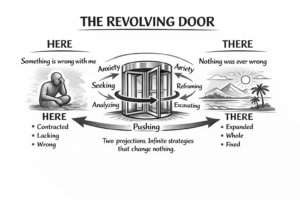
Because you were pushing on a revolving door.
The Door
Here’s what I couldn’t see while I was inside it:
Every breakthrough had the same structure. I started in HERE — contracted, seeking, something wrong. I pushed toward THERE — open, clear, arrived. The push worked. I landed in THERE. It felt real. It felt final.
Then THERE became the new HERE. The openness became the baseline. And the moment new pressure arrived — a difficult conversation, an old trigger, a sleepless night — the contraction returned. Now I was in HERE again, pushing toward THERE again.
The door kept turning because I kept pushing.
Not because life kept failing me. Because pushing is what the door does. Every push creates momentum to the other side. Every landing becomes the new starting point. The door doesn’t have an exit. It has the illusion of one — and the illusion refreshes every time you push.
Both Sides Are Projections
This is the part that took years to see.
HERE — “something is wrong with me” — feels absolutely real. The contraction is real. The tightness is real. The activation is real. But the story attached to it — broken, inadequate, behind, not enough — is backfill. The nervous system activated first. The story arrived second, to explain the activation. HERE isn’t a location you’re standing in. It’s a narrative projected onto a sensation.
THERE — “I’ll be whole” — also feels real. Especially during a breakthrough. The openness is real. The relief is real. But the story — arrived, healed, awake, done — is also projection. THERE isn’t a destination you’ve reached. It’s a narrative projected onto the absence of contraction.
Both are movies playing on closed blinds.
When the blinds are closed — when the nervous system has flipped into protection mode — the mind projects HERE on the current sensation and THERE on the imagined relief. You can’t see reality directly. You can only see the projection.
And every push from HERE to THERE is a push inside the projection. You never leave the theater.
What the Push Actually Looks Like
For three years I thought I was doing deep work. And I was — the breakthroughs were genuine. But I couldn’t see the push because it was wearing different costumes.
Sometimes the push looked like analyzing. Understanding the pattern so clearly that I wouldn’t have to feel it anymore.
Sometimes it looked like seeking. The next teacher, the next practice, the next framework that would finally be the one.
Sometimes it looked like reframing. “This contraction is actually growth.” The sensation hadn’t been felt. It had been relabeled.
Sometimes it looked like excavating. If I could just find the root — the original wound, the childhood moment — I could pull it out and be free.
Sometimes it looked like comparing. “I was more open last week. Something’s wrong today.” Turning direct experience into a performance review.
And sometimes — this was the subtlest one — it looked like watching myself watch. “I notice I’m noticing the sensation.” It felt like awareness. It functioned as distance. I was meta-observing my way out of contact while believing I was doing exactly what I was supposed to do.
Eight exit doors from the revolving door. I used all of them. Each one felt like engagement with the work. None of them were contact with what was actually here.
Why It Keeps Spinning
The door spins because pushing is what the mind does when internal sensation gets treated as threat.
Something activates. The nervous system braces. And in that brace, a prediction fires: something here could be damaged. My worth. My competence. My stability. My belonging. The mind doesn’t know what — it just knows the activation means danger.
So it pushes. Toward understanding. Toward relief. Toward the next experience that will make this feeling stop.
The push IS the revolving door. Not a metaphor for it. The push itself — the urgency to get from this feeling to a different one — is the mechanism that keeps the cycle alive.
And here’s why breakthroughs don’t last: the breakthrough resolves the current push. The contraction releases. THERE arrives. But the mechanism that generates the push — the nervous system treating internal sensation as threat — was never touched.
So the next time activation fires, the same prediction runs: something here could be damaged. And the push starts again. Different content. Same structure. The door turns.
What I Found at Gibraltar Point
Chapter 10 of the book. A summer evening. My daughter asking if I wanted to swim.
The contracted “no” and the open “yes” both present — and for the first time, not at war. Both held in the same space. Right action arising on its own. No alarm. No manager.
That held for weeks. I thought I’d arrived.
Then one midnight in the kitchen, the contraction came back and wouldn’t open. I tried to hold both forces. Nothing. The technique had become something to master. The recognition had become something to maintain. Both collapsed under the weight of ownership.
Gibraltar was real. The discharge was real. The peace was real. And it didn’t last — because I never checked what the forces had been fighting for. The alarm went quiet, but the thing the alarm was protecting? Never tested. Never looked at. Never exposed.
So the mechanism kept its reference point. The assumed target — the “me” that could be damaged — was still intact. And when new pressure arrived, the protection rebuilt around the same untested center.
Discharge without verification. Relief without discovery. I stood in the doorway and called it the destination.
The revolving door, doing what it does.
What Happens When You Stop Pushing
Months later. The bath. Chapter 15.
Same two forces. Same gate opening. But this time the revolving door had taught me what pushing gets you. So I didn’t push through the open gate. Didn’t grab the peace. Didn’t declare arrival.
I stayed with what was underneath.
And underneath the fortress — underneath sixty years of protection — was just unease. Uncomfortable sensation I’d rather not feel.
That was it. The whole thing. A cathedral built around a grain of sand.
“I can live with this,” I said out loud. And then I started laughing.
Like checking under your bed for monsters every night for sixty years. Heart pounding. Certain something dangerous lurks there. Building an entire fortress to protect yourself from whatever might be hiding.
Then finally turning on the light.
And finding a sock.
The Difference
Gibraltar: the forces stopped fighting, the alarm went quiet, and I called it a breakthrough. I was right — something real happened. But I never looked at what the forces were defending. So the mechanism kept its reference point and rebuilt when pressure returned.
The bath: the forces stopped fighting, the alarm went quiet, and instead of celebrating the open gate, I looked inside. What was all that protection wrapped around? A sock. Just sensation. Uncomfortable. Survivable. Not a threat to anything.
That’s the difference between a breakthrough that fades and one that sticks. Not the quality of the experience. Not the depth of the opening. Whether you checked what the alarm was protecting.
The revolving door stops when you stop pushing and feel what’s underneath. Not the story about what’s underneath. Not the analysis of what’s underneath. The actual sensation.
It’s not pleasant. It’s not comfortable. It’s not a cosmic experience.
It’s a sock. And you can live with a sock.
The Contractions Don’t Stop
If you’re reading this hoping the revolving door leads to permanent peace — it doesn’t.
The contractions still fire. Every day. New triggers, new pressures, new versions of the same activation. The alarm still rings.
What changed isn’t the frequency. It’s the relationship.
Before: every contraction was an emergency. Evidence that the monster was still under the bed. A reason to push — toward understanding, toward relief, toward the next breakthrough that might finally be the last one.
Now: a contraction fires. I feel it. Maybe hold both forces for a moment. Then check — where would this land? Who gets hit? And find: nothing. The sock again. Seconds instead of decades.
Not because I mastered a technique. Because the target was already proven absent. Each contraction is just the nervous system running old code. The reflex persists. The belief behind it doesn’t.
Recognition is a moment. Familiarization is the rest of your life.
The Question
If your breakthroughs keep fading — if you keep arriving somewhere real and then losing it — the problem isn’t that you need a better technique or a deeper practice.
The problem is that you’re pushing.
The revolving door doesn’t have an exit on the other side. It has one underneath.
Stop at the door. Feel the push. And ask: why am I pushing? What am I running from?
Not the story. Not the analysis. What’s actually here, in the body, right now?
It’s probably not what you think.
It’s probably a sock.
Michael Harris is the author of Clear Seeing: No Target to Defend. This is the first in a series on the mechanisms that keep the seeking loop alive.
If you recognized yourself in this article, the Clear Seeing Guide APP runs the same check described here — in real time, with whatever you’re carrying right now